Visual embeddings
Fabric photographs become searchable feature vectors that support fine-grained visual comparison.
Applied Computer Vision
AI-powered Fabric Identification
Identify upholstery fabrics in seconds using computer vision, visual embeddings, and local catalog retrieval.
The Problem
A physical swatch may arrive without a readable name or code. Lighting, texture, camera distance, color variation, and incomplete context can turn a simple catalog question into a slow manual search.
Swatch ID narrows the problem to something useful: match a normal photograph against a known fabric catalog and return the closest candidates. It is practical visual search, not generic image classification.
The Product
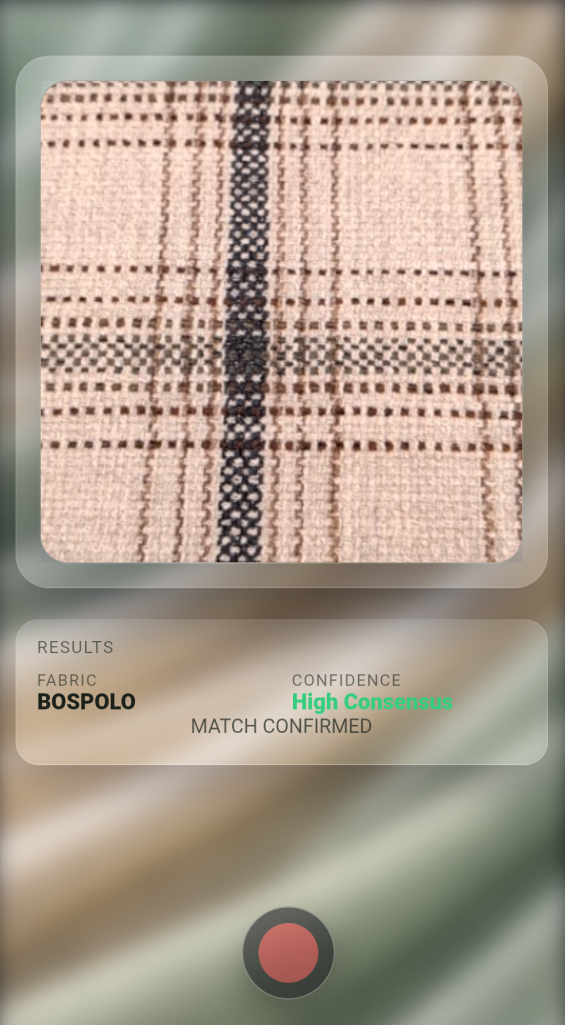
The lookup experience is intentionally direct: capture the fabric, search the indexed catalog, and review the leading result with confidence feedback. The interface keeps the model work in the background so the user can stay focused on identification.
How Swatch ID Works
The same visual representation used to index known catalog examples is used for each lookup image, making similarity search the bridge between a physical sample and its digital record.
Reference fabric images and identifying metadata form the searchable collection.
The photographed sample is prepared for consistent visual comparison.
A vision model converts the image into a numerical representation of its visual features.
Similarity search compares the query embedding with indexed catalog examples.
The closest catalog results are ordered as likely matches rather than treated as generic labels.
The interface presents the leading match with confidence-oriented feedback for review.
Behind the Lookup
Swatch ID combines computer vision and retrieval with an interface built around fast, confidence-aware lookup. The architecture stays grounded in a controlled catalog rather than claiming open-ended recognition.
Fabric photographs become searchable feature vectors that support fine-grained visual comparison.
Lookup is constrained to a known indexed catalog, keeping the result tied to useful fabric records.
The product surfaces match strength to support a practical human-in-the-loop decision.
Catalog images, embeddings, and retrieval can stay close to the workflow instead of requiring a public image service.
Real-World Value
Swatch ID applies AI where the benefit is concrete: reducing lookup friction while keeping a person in control of the final identification. The same pattern can support material-heavy workflows where samples and digital records need a faster connection.
Fabric catalog lookup
Product-development sample identification
Manufacturing support
Internal reference tools
Human-in-the-loop material identification
See the Workflow