Problem
Finding a specific fabric roll in a rack photo should not require manual box-by-box searching.
In warehouse-style storage, operators often need to locate a specific roll number across large rack sections. Labels may be visible, but rack distance, glare, curved label surfaces, print wear, and image compression can make direct reading difficult.
Bolt Finder addresses this as a practical computer vision problem: process a full rack image, extract roll-number candidates, compare against an operator-entered target, and highlight likely matches in a clear overlay.
Prototype Goal
A simplified operator workflow that works end-to-end on real rack imagery.
The first working version is intentionally focused on a narrow operator loop: upload image, enter target roll number, run scan, and review the highlighted result.
This keeps Bolt Finder practical and testable: reduce lookup friction, provide honest match/review states, and preserve human confirmation where image quality is imperfect.
Early Assumption
Barcode-first looked reasonable initially, but rack-distance image quality made it unreliable.
The project originally explored barcode and detection-heavy assumptions, since barcodes are structured identifiers and can be strong signals in controlled capture conditions.
Real furniture roll captures exposed the limitation: glare, curvature, label wear, print quality variation, compression artifacts, and limited barcode resolution reduced decoding reliability at rack distance. Barcode scanning remains available as a diagnostic path, but is deprecated from the primary operator workflow.
Current Architecture
OCR-first is now the working primary path.
Bolt Finder now runs an OCR-first rack scanning pipeline that can process large warehouse-style images, detect multiple label regions, extract target-like text candidates, and classify match vs review outcomes.
The working architecture is: OCR → Candidate Extraction → Match Classification → Overlay Display. This is a functioning proof of concept, not a production-ready deployment, and current work is focused on refinement and hardening.
Workflow Direction
Simple operator steps backed by OCR-first rack analysis.
OCR-First Rack Scan
Upload Image
Operator uploads or captures a warehouse-style rack image.
Enter Target Roll
Operator enters the roll number or identifier they need to locate.
Run OCR Scan
The system runs full-image and tiled OCR passes with preprocessing variants.
Extract Candidates
OCR fragments are merged and scored as possible roll-number candidates.
Classify Match
Candidate text is compared against the operator-entered target.
Highlight Result
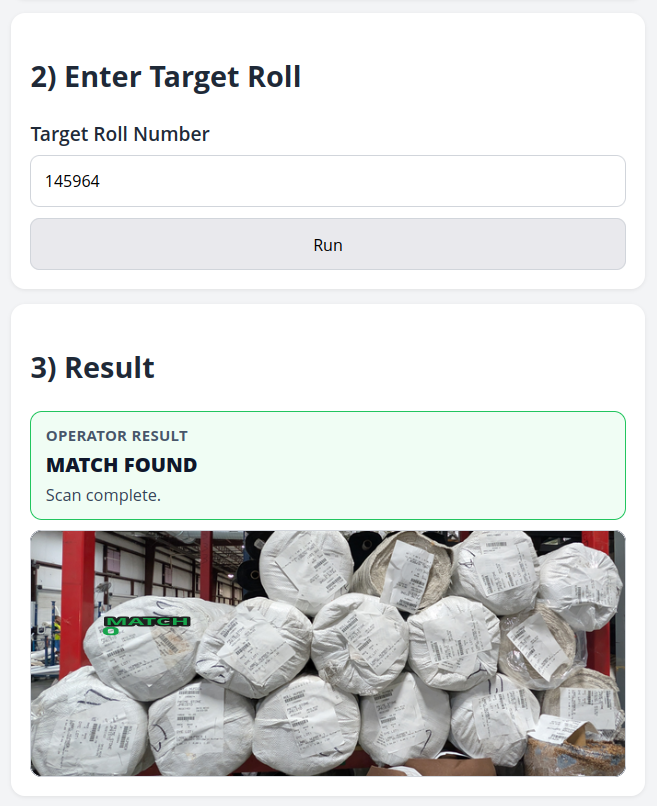
Matching labels are highlighted while lower-priority review boxes are suppressed when a match is found.
Prototype Visual
OCR-first rack scanning workflow
Bolt Finder scanning a warehouse-style rack image, extracting roll-number candidates, and highlighting operator-facing match results.
Technical Direction
Built as an OCR-first pipeline tuned for rack-scale label discovery.
The current prototype has moved past mock workflow testing and now executes a real OCR-first scan path across warehouse-style imagery. The focus is practical extraction quality and operator clarity, not model complexity for its own sake.
Full-Image OCR
The full rack image is processed first to capture obvious readable label text across the scene.
Tiled High-Resolution OCR
Large images are scanned in tiles to recover higher-detail text that can be missed at single-pass scale.
Preprocessing + Fragment Merging
OCR preprocessing variants improve read quality, and split fragments are merged to reconstruct likely roll numbers.
Candidate Scoring + Classification
Candidates are prioritized, then classified as exact-match or review against the operator-entered target with overlay display feedback.
UX Direction
Overlay clarity is now prioritized for operator readability.
The current workflow reduces visual clutter by prioritizing high-confidence match overlays. When a match is found, lower-priority candidate/review boxes are suppressed so operators can focus on the actionable result.
This change materially improves interpretation speed: less overlay noise, clearer match state, and easier scan-to-decision behavior in rack imagery.
Lessons Learned
Readable signal quality determines architecture choices.
The barcode-first path surfaced an important real-world constraint: if the captured barcode signal does not survive rack-distance conditions, decoding reliability falls quickly. That lesson directly shaped a better architecture.
OCR-first became the more practical path because enough text signal could still be recovered from real captures. Just as importantly, simplifying the operator workflow mattered as much as improving recognition itself.
Status and Next Steps
First end-to-end OCR-first proof of concept is working; refinement is next.
Bolt Finder has reached a successful working-prototype milestone: end-to-end OCR-first rack scanning and match highlighting on real warehouse-style imagery. It is not a production-ready deployment, and is now entering optimization and production-hardening work.
Next steps include additional OCR tuning, improved roll-number grouping, stronger confidence ranking, better duplicate suppression, creation of a real-world label image test set, and expanded warehouse validation testing.